- The Arrow
- Posts
- The Arrow #261 Books, Books, Books
The Arrow #261 Books, Books, Books

Michael Eades
December 17, 2025
Thanks to everyone who offered condolences on the loss of my friend. I’m a fairly gregarious guy and have a ton of social acquaintances, but not many close friends. He was one, so his demise really hit me hard. All your kind words were appreciated.
It just dawned on me that what with Christmas just around the corner, I need to update my Amazon wish list. I tend to throw books on there that I just have an interest in along with those I really want. Then if I’m wandering around in a bookstore, I can seek out those that struck an interest and take a deeper look before purchasing. By not updating my wish list, I’ve ended up getting books I don’t really want.
I was reminded of books because of a Substack I received a couple of days ago by Ted Gioia, one of my favorite writers, titled “What happened to the library.” Most of it is behind a paywall, but the substance of the article is the same thing I wrote about a few weeks ago. Shelves that used to be filled with books are now filled with merchandise, which Ted and I both attribute to a fall off in book reading. I’ve read other articles on the same subject, so it’s not a phenomenon that has gone unnoticed.
Reading all this reminded me that I should put up a few books I’ve really enjoyed in the last few months. You might find them interesting, or, if not to your own taste, maybe as a gift for the holidays coming up.
Ballistic
The first book is titled Ballistic: The New Science of Injury-Free Athletic Performance.
It’s about a guy who grew up as a free-range child in the area just north of Santa Barbara. He was a pretty good athlete, and while playing high school football, he sustained an anterior cruciate ligament (ACL) tear. He had never endured anything as painful. It screwed up his football career, but got him thinking about why some people sustain these injuries and some don’t.

He ended up going to the University of California in Santa Barbara, then to Harvard Medical School. He found medical school too regimented (who, who has ever been through it, hasn’t), but hung in until graduation. He then went to Cape Town, South Africa to work with Tim Noakes, who is a friend of mine.
Most people who know of Tim Noakes now think of him as a low-carb/ketogenic diet guy, but that’s just his second career. Before that, he was one of the world’s great authorities on endurance exercise. Tim’s research demonstrated that we get fatigued by feedback from our brains, not because of our muscles. His work has helped many people break through endurance walls once thought impossible.
Tim was also a believer in carb loading. Until he came down with type 2 diabetes and was able to get and keep his blood sugar and HgbA1c normal with a low-carb/ketogenic diet. He then refuted all his former work on diet, which was extensive, and started doing research on low-carb. Which is how my life crossed with his.
Dr. Marcus Elliott, the protagonist of the book, worked with Tim on endurance exercise and injuries. After a couple of years he came back to the US and started his own independent study of why some people get ACL tears and other major injuries while others who play just as hard don’t. He made it his mission to find out why. And how to prevent them. (Note: Micah Parsons, Patrick Mahomes, famous NFL players, both experienced season-ending ACLs yesterday.)
He learned early on that the exercise regimen should be specific for a specific sport. He knew, for example, that in the NFL trainers made linemen run to improve their endurance. He realized quickly that a typical play in football lasts maybe ten seconds. Why, then, should linemen run for hundreds of yards? Surely there were training regimens that would better equip them for maximal output over ten seconds than running.
He got involved with the NFL, but discovered the trainers were too hidebound to try anything new.
He then approached major league baseball. Baseball is a sport that is almost completely rotational. But he ran into the same trainer resistance, leaving him to remark that “baseball is the dumbest sport.”
He finally caught on with basketball and figured out why some players were much more prone to ACLs and other dreadful injuries than were other players. Then he figured out what kind of exercise it took to prevent the injuries, which was his goal since his own ACL.
Now he runs a facility in Santa Barbara (and is in the process of opening one in Atlanta), where the NFL and the NBA sends players who are prone to ACLs to prehab (my invented word) them.
It’s a fascinating book that I’ve been recommending to everyone I know who is playing any kind of sport, including golf. I’m doing many of the exercises myself.
There is a nice review in the Wall Street Journal, which is where I learned of the book. It would be a great gift for anyone you know who is heavily into sports of any kind.
But I would warn them not to go to the airport with Dr. Elliott.
If you would like to support my work, take out a premium subscription (just $6 per month).
The Vietnam War: A Military History
The next book on my hit parade is The Vietnam War, which I’ve already mentioned a time or two. It’s a long book, but very well written. In fact, as I wrote before, it so well written it almost reads itself. Because it is so well written, you can probably read it in the same time you would read a book half its size. I had never heard of the author, so I looked him up. He is a noted military historian. It’s difficult to find experts in any field who can write as well as Geoffrey Wawro, the author of this one.
Here are the opening lines:
Vietnam was a war of choice. Understanding it requires a reckoning with this stubborn fact. The United States was not provoked into war, and none of the Cold War justifications of containment or the "domino theory" required the US military to intervene. If South Vietnam fell to a communist insurgency, the Chinese or the North Vietnamese were not going to "land on the beaches of Waikiki" -- as Vice President Lyndon Johnson rather daringly warned in 1961. It was not a war fought in self-defense or for democratic ideals. What motivated the United States to go to war and stay there was a fear of appearing weak.
John F. Kennedy was the first president to fully appreciate the danger Vietnam posed, not to the United States but to himself. Just as Eisenhower had feared Senator Joe McCarthy's Red-baiters, Kennedy and Johnson feared being tarred as liberal doves by conservatives. Johnson scaled up the war effort out of the same fear, while Nixon dreaded becoming "the first president to lose a war."

As I’ve written before, I was in college during the last half or so of the Vietnam War and I was fighting getting drafted as hard as I could. I wanted to be a Navy pilot, which I couldn’t be without a degree. The draft board didn’t give a crap, and they were pursuing me hard and fast. I ended up writing a letter to LBJ (which I’m sure is in the archives of his presidential library—they save everything—telling him my situation.) I had driven home from my summer job with the U.S. Forest Service in Bridgeport, California (about a nine-hour drive) to take my draft physical, which I passed with flying colors. Before I drove back, I wrote the letter to the president. I expected nothing, but that letter ended up saving me. I keep wanting to go to LBJ’s presidential library to see if I can find the letter, but I have no reason to go there other than that. If I’m in the neighborhood at any point, I assure you, I will look for it.
Not long after my close encounter with the draft board—and you wouldn’t believe how close—the war started to wind down. My interests had changed from aviation to SCUBA diving, so I became more interested in the Coast Guard. But since there was no longer any urgency, I just kind of forgot about it till the whole thing was over and Nixon had canceled the draft.
Early on I felt kind of bad about not going. Those feelings have dissipated over the years, but I can tell you that after reading this book, I can’t tell you how happy I am I didn’t go.
The whole thing was a screw up from beginning to end. The North Vietnamese and the Viet Cong were winning the war from the get go. The Americans didn’t have a chance. Just the number of replacements the North Vietnamese forces could muster to replace their dead were vastly larger than ours.
Our generals could not believe that we, after triumphing in WWII, couldn’t defeat a little raggedy-assed country (as LBJ called it) in a matter of months. He realized the huge expense the war entailed. At first it wasn’t all that much, but as General Westmoreland, who was running the operation kept demanding more and more troops, the costs skyrocketed.
Just today, I read a quote (not from the book, but from another article I was reading) about LBJ. He told his historian Doris Kearns Goodwin “If I left the woman I really loved — the Great Society — in order to get involved with that bitch of a war on the other side of the world, then I would lose everything at home.”
What LBJ really wanted was the Great Society he had conceived, but due to the escalating funding that was demanded, he saw his pet project threatened.
After reading this book, my heart breaks for the 50,000+ young people—mostly my age—who died needlessly because of a bunch of feckless politicians who didn’t want to look weak. Politicians, in general, are not my favorite people, but those of that era are despicable.
According to these politicians, we were fighting over there to keep communism away from our own shores. Vietnam is now more of a capitalist country than we are.
Imagine You Are An Aluminum Atom
I learned a huge amount of information from this small book. I’m embarrassed to say that I had always thought aluminum was another metal we have in our bodies. We have iron, which makes our red blood cells work to carry oxygen. Magnesium is a cofactor for countless enzymatic reactions. I had just assumed that aluminum was right in there with them.
Boy, was I wrong.
First, aluminum in all of its myriad forms is superabundant; it is the third most abundant element (after oxygen and silicon) of the Earth’s crust.
Second, aluminum is superreactive; it is both chemically and biologically reactive. However, these two red flags identify a paradox, as the abundant and biologically reactive aluminum has no biological function either in any organism today or in any extinct biota from the evolutionary past.
This in turn means that all of our encounters with aluminum are adventitious, random, and chaotic. There is no aluminum homeostasis, no protection against it, and no controlled elimination.
When, in 1889, Charles Martin Hall invented a process of extracting aluminum metal from its ubiquitous ores of the Earth’s crust, it heralded an age as important as any before or since.
In other words, we—and all living creatures—had never had exposure to aluminum in a form that can get in the body until 1889. Consequently, as the author says, “All of the aluminum found in, or associated with, the human body has the potential to result in toxicity.”
The only form that can make it into the human body is Al3+(aq).
The author of this book is the world’s expert on aluminum and the many disorders it causes.
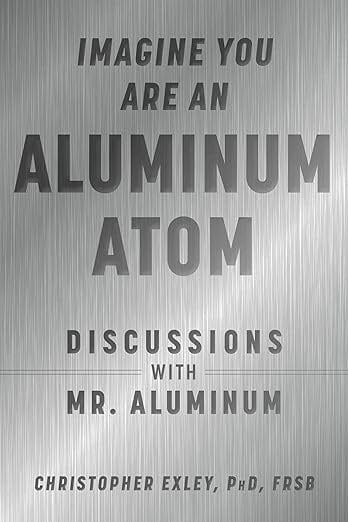
He has had a struggle his entire career, much in the same way those who tried to publish on vaccines or COVID or any other product where huge money is involved. Just like there is Big Food and Big Pharma, there is also Big Aluminum. Like the other two, Big Aluminum controls the journals, so it’s tough to get published. But as of 2020, when this book was published, the author, Christopher Exley, PhD, has had some 200 papers published. Most of which were savaged by Big Aluminum.
Even though it is a small book, I learned a lot from it. Since aluminum isn’t natural to the human body, no one really knows how to measure it exactly. And they don’t know how to measure the flux, i.e., how much goes in and how much comes out.
Here is a graphic from the book showing where we get aluminum and how we get rid of it.

As you look at this graphic, it’s pretty obvious that aluminum’s ability to get into our bodies has a lot more pathways than it has to get out. There are countless creams and sunscreens and deodorants that we smear on fairly often, but then we’re looking at our hair growing out to get rid of it. As you read the book, you’ll see why it is so tough to get rid of and so easy to take in.
About the only proactive thing you can do to get rid of it is to drink a lot of water that is high in silica. That will remove it, but still slowly.
One big use of aluminum, not surprisingly, is in vaccines. Many vaccines use aluminum as an adjuvant to increase the inflammation and end up evidencing an antibody response.
The use of aluminum salts as adjuvants in vaccines has a long history going back over one hundred years, and I have spoken about this history on numerous previous occasions.
In comparison to other adjuvants, both historic and still in use today, aluminum salts are adjuvants of choice for a number of reasons.
They are sufficiently toxic, without being too toxic, at the vaccine injection site to be effective in boosting the immune response.
They are unregulated, which means that vaccine manufacturers can use as much aluminum in a vaccine as they require.
Above all, they appear to work, loosely defined, and almost no understanding of their modus operandi seems to be required by vaccine manufacturers or their regulators, our safety bodies, such as the FDA and the EMA. The old adage seems to apply: “if it ain’t broke, don’t fix it.”
There is no requirement of vaccine manufacturers to demonstrate that aluminum adjuvants, the most critical component of this type of vaccine, are safe for use in humans. Consequently, there are no safety studies, and there are no aluminum adjuvants approved for use in human vaccines.
However, the validity of safety tests, such as they are, for whole vaccines that include an aluminum adjuvant is brought into question when one considers that not a single aluminum adjuvant vaccine in use today has been tested against a true placebo or control.
Pathetic is the word I would use for the whole operation. I highly recommend this small book for the wealth of information it contains. Although I ended my review kind of heavy on vaccines, but vaccines are not the only way to load up on aluminum. There are countless ways we all take it in every day. And since it is so difficult to get rid of, I think it’s a lot easier to not get dosed with it in the first place. There are a lot of ways to get dosed, so beware.
I hope I’ve given you a few books you might not have otherwise found. Grab one or more for your own reading pleasure. And grab one for a Christmas gift for someone who might enjoy it.
That’s about it for this week. Keep in good cheer, and I’ll be back soon.
Please help me out by clicking the Like button, assuming, of course, that you like it.
This newsletter is for informational and educational purposes only. It is not, nor is it intended to be, a substitute for professional medical advice, diagnosis, or treatment and should never be relied upon for specific medical advice.
Thanks for reading all the way to the end. Really, thanks. If you got something out of it, please consider becoming a paid subscriber if you aren’t yet. I would really appreciate it.
Finally, don’t forget to take a look at what our kind sponsors have to offer: HLTH Code, Precision Health Reports, and Jaquish Biomedical.
And don’t forget my newest affiliate sponsor Lumen. Highly recommended to determine whether you’re burning fat or burning carbs.
Reply